
The Darkest Darkness
Where my transformation began


After recent conversations with StoicMom, I am reflecting on my journey as Walk with Mom. I have started to think about how I arrived at the path of connection with my trans-identified adult daughter, and why I now feel better able to manage our profound challenges. I recall how dark things were at first, and how critical that darkness was to finding my way to health and a much better relationship.
As readers may know, I focus on maintaining a connection with my daughter. I do not affirm or deny her trans identity. I know she needs my unconditional love, and I also believe that she needs my gentle, well-timed and carefully crafted honesty. I think of my approach as combining both courage and compassion — courage to be truthful and to risk the consequences of her rejecting me, and compassion to deliver the truth gently. I have reoriented myself to reframe how I think about her gender struggles. I believe that she is using what is available to her — including a trans identity — to cope with psychological distress. I work to maintain a connection to protect our sacred mother/child bond and the health of our family. In light of the demands she places on our family, this is a fragile dance — challenging, exhausting, and fraught with risk.
When she first announced she was trans last year, I knew, in my body, that I could not affirm the identity. I sensed — but could not yet articulate — that my connection with her would be critical; that sense was buried deep within me, an intuition and trust in the power of unconditional love. It was all I really had to guide me in those early days.
Back then, I struggled alone — I read, listened, learned, and felt my way. In my darkest moments, I was isolated from my closest family and friends, aching from loss, grieving for innocence, and furious that the culture had stolen my child; I felt as though I had been hit by a truck, dumped on the roadside, left for dead. Everything looked and felt different. I could not talk to anyone about what I was experiencing. I was lost, disoriented, wondering where I was, who I was, and what had happened to my known life.
One of my greatest fortunes during this period was stumbling upon StoicMom on Substack. I was already reading in religion, spirituality, and philosophy to try to manage my life, trying to apply ancient wisdom to my challenges, when someone in a Substack comment somewhere linked to her — stoic, and a mom, cool! — and I started reading her essays and listening to her podcasts. When I heard her invite parents to reorient themselves to their circumstances, something immediately clicked for me. That was when I joined the StoicMom Project and learned about the dark night of the soul.
When I first heard that phrase — “dark night of the soul” — I experienced a moment of relief. I knew immediately it described my situation; that was exactly where I was. And suddenly, while I had been lost before, I could now locate myself within a known human experience — a terrible one, but at least a place that was known to others. It was a start.
I found my way to Dark Nights of the Soul: A Guide to Finding Your Way Through Life's Ordeals by Thomas Moore and encountered the framework — that darkness is a built-in feature of the human experience, not a pathology. I started to apply the framework to my life, asking what purpose the darkness was meant to serve, what lesson was I meant to learn from this despair.
Also during this dark time, I decided to consider my "shadow.” I had heard StoicMom use this term, and I’m a fan of the podcast, This Jungian Life, so I accepted the possibility that I needed to do “shadow work” as it is called, even though I didn’t fully understand the whole framework or have all of the vocabulary. The way I understood it, my shadow consisted of the dark things in my life — my past — that I needed to dig up, identify, and face in order to make peace. What would happen after this, I had no clue. But others seemed to trust that making peace with and integrating the shadow can help us become whole and then cope with our lives. Were they right? Was this a way out of the dark night of the soul? And still I wondered, what was this dark night meant to teach me? I truly had nothing to lose. (By the way, I may have this Jungian thing all wrong, so my apologies to the Jungians who may be reading this — I welcome your corrections in the comments! I write this here to recount my experience, not to teach or model specifically Jungian approaches.)
I recall I was sitting on my bedroom floor, when, in agony, I pretty quickly knew that I needed to go back to what I had buried long ago. I needed to go back to my transition to motherhood and my experience of childbirth.
So I began to recount to myself my birth stories and the challenges. Becoming a new mother was easy and natural, and I also experienced periods of confusion, loneliness, and doubt. (I would have benefited from the amazing Substack moms in those days.) During my second pregnancy, however, I developed full blown depression. This condition knocked me out. I failed spectacularly, and I didn’t even care that I failed. I was unrecognizable to myself. The baby cried all the time from colic. My support system — husband, parents, sister — sprung into action to care for her while I lay in bed, lifeless. I turned away from her cries. It was unforgivable. Luckily, once I got better, I moved on and quickly bonded with her. There are pictures that I treasure from this time, evening sun, deep laughter.
For all of these years, I buried the deep guilt and shame of not being able to care for her, of turning from her, of failing. And these were the very things I needed to face. After all, this colicky baby, this beloved child — this is my daughter who now identifies as trans. Like other moms, I had been blaming myself for her gender issues — if only I hadn’t been depressed … if only I had bonded with her sooner… if only I had done this or that differently during her childhood.
The darkness I was experiencing, which had been brought on by her rejection of womanhood and me, invited me to open my old wounds of my postpartum depression. And seeing them from my perspective now, as a 53 year old woman who was also about to become a grandmother, I started looking at my younger self differently.
I realized that I didn’t ask for postpartum depression. I had done the best I could to get better for my family. Was I blameless for my depression? How could I blame myself now for being sick then? What could I have done differently? What did it even matter if my depression had in fact caused her identity issues? What could I do about it now? Could I forgive myself for what I had previously found to be unforgivable?
Around the same time, I also heard StoicMom asking other SMP parents, what if this is not your fault? What if this is part of your child’s journey, your child’s individuation? I looked around at the loving, competent mothers, devastated by their children’s confusion, self-harm, and alienation. It seemed clear that there was something else going on in the culture. Being part of the SMP helped me see myself more clearly. And I started considering new ways of thinking about my daughter’s situation and appreciating that I could think differently about myself as well.
I realized that blaming myself wouldn’t actually help. I could not change the person I was back then anymore than I can change my daughter right now. I realized that I had to either accept that I did what I did, or. … what? … continue to suffer now for failing to bond decades ago? I held the keys to stopping my own suffering.
I looked directly at the darkest darkness in my life, and I changed my stance from self-blame and shame to curiosity. I wondered if I could view myself differently, and with more compassion. I wondered if maybe my dark night was inviting me to see that it was time to let go. I saw that there is grace in forgiveness; there is softening, compassion, understanding, and I wanted that. I wanted to live in grace. I wanted to allow myself softness. I wished things had been different back then, but I couldn’t change who I was or how I was. The only thing within my control is the present. Something shifted. I could feel it shift. And I forgave myself.
Almost immediately, I felt relief from my suffering. Things became lighter. I could still feel the pain of my daughter’s struggles, but I also became aware of my own limitations — of what I can and can not control. The serenity prayer had new resonance now. I felt there was something larger than myself, and I surrendered to it.
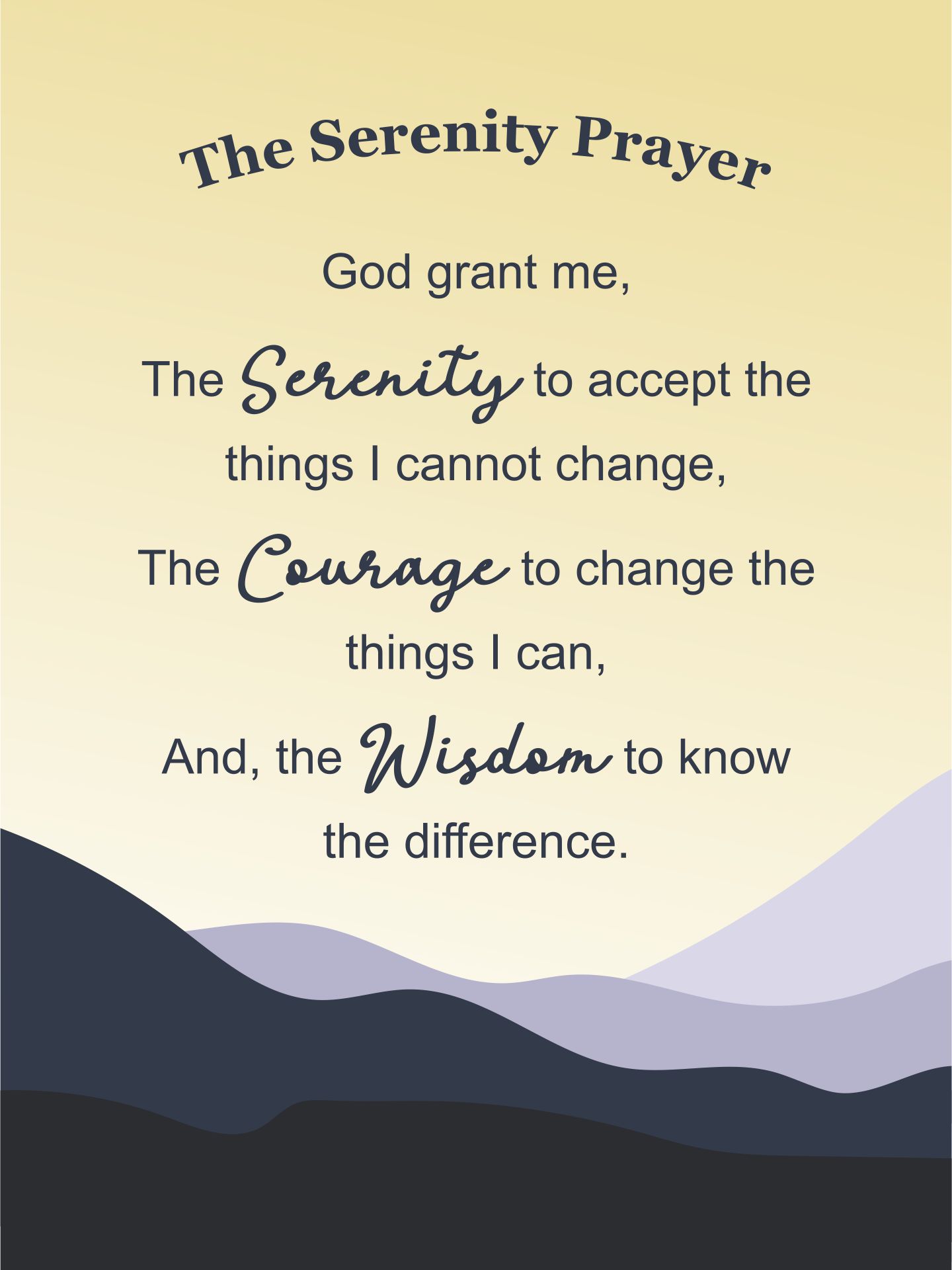
During my journey of transformation, I had to go to where the darkness was darkest in order to bring on the dawn. That darkness taught me the lesson of grace and forgiveness. Once I forgave myself, and once I was able to accept that things are beyond my control, I was able to understand that my daughter’s trans identity was not a direct result of anything I did. It just was. And forgiving myself helped me see that I had been operating within the illusion that I was in total control of my life and my choices. I am not. I am in control of some things, but not every thing.
Trying to live in the present moment, which has always been critical for me, was not sufficient for my transformation. I also had to surrender to what I could not control, and find a new kind of faith in what is beyond us, in order to become stronger and more ready for life’s challenges. I now have access to the sense that I am not alone in the universe, a sense that I cultivate with prayer.
With practice, I am getting better at facing the daily challenge of walking the path of connection with my daughter. It really is a daily challenge. It gets easier with practice, but it is not easy. Every day I practice recognizing the challenges, discerning how much I can influence and how much I need to let go, and guiding myself toward peace.
This is powerful, vulnerable, honest stuff. Thank you. " Once I forgave myself, and once I was able to accept that things are beyond my control, I was able to understand that my daughter’s trans identity was not a direct result of anything I did. It just was. And forgiving myself helped me see that I had been operating within the illusion that I was in total control of my life and my choices. I am not. I am in control of some things, but not every thing."
WOW.
All of this resonates deeply. I work with StoicMom as well, and have benefited greatly from her gifted and powerful support. I don't affirm or deny my daughter's identity - though in working hard to maintain my connection I honor her new name (of 4 years now) and pronouns. She knows that I support her independence, and am also there to support her concretely when she needs/wants this. *I know she is doing her best.* I love her unconditionally. I do my own best to live my life to its fullest, riding the waves as they swell and diminish and realize I am modeling for her as I do. My struggles, however, have refreshed in a new way now that my child is actually getting injected with testosterone and the changes are happening -physical and attitudinal - front of my eyes. I see the value in having faith in "what is beyond us", and at the same time when what is actually in front of me is my beautiful, struggling, emotionally beleaguered child, the dance of what I can do and let go of becomes much, much more intricate and complicated than it seemed before.
Your beautiful words make so much sense. I am trying to imagine my path's trajectory as a spiral - though it seems like I have been in this place of dark struggle before I am now on a different level. Keeping close to my heart that despite the changes in look and attitude, despite the risks to her physical, mental, sexual and reproductive health that the core of her is lovely and lovable and I will be there for her - in whatever form - no matter what. AND there continue to be those "in the moment"s that feel like a punch in the gut knowing that this is happening.